Articles

Fuel use, efficiency, and ocean-crossing

There is a fairly large gap between theoretical fuel consumption and actual (ocean crossing) use. Let’s look a little more closely at real fuel consumption.

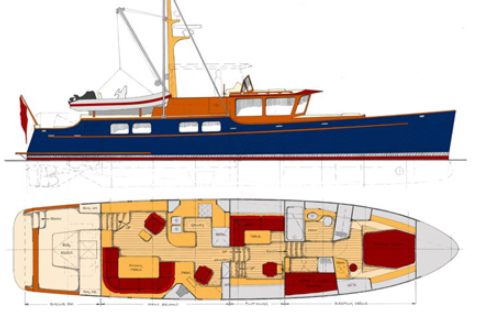
The Passagemaker Lite hull form is reasonably efficient under power; the form minimizes wave making and form drag with a long waterline and narrow beam. But there is a fairly large gap between theoretical fuel consumption and actual (ocean crossing) use. Let’s look a little more closely at real fuel consumption.

Like all problems involving boat design and the ocean, these differences, (theoretical to actual) are due to numerous variable factors. The two main factors involved are drag (resistance) and thrust (propulsive power).

Theoretical resistance models deal with wave making and wetted surface resistance. The forms of resistance not taken into account include bottom roughness and growth, wind and wave resistance, current and tide, and appendage drag. Thrust at the propeller and what the engine has to produce are different because of power loss in the system. There are alternators and water pumps running which require HP, there are loses in the gearbox and propeller shaft bearings, and propeller efficiency ranges from 50-70%. Power output and engine efficiency will also vary with fuel and air temperature.

While the PL 46 (bare hull theoretical model) does show a speed of slightly over 6 knots using somewhere between 9 and 11 Hp, that is Hp delivered at the propeller. It is without appendage drag, wind or waves or currents, etc. In reality few moderately sized modern engines will operate long term at that low an RPM. If the engine is run long term below operating temperature there will be damage. So 1200 RPM is probably minimum, and minimum fuel burn (real world ocean cruising) is probably closer to 1.3 usg/hr. or about 4.9 liters per hour for a speed of 6-6.5 knots. This is the speed and fuel use achieved by IdlewildIdlewild on her recent circumnavigation using a single 55 HP engine.

The designed fuel capacity of the PL 46 is 860 usg or about 3250 liters. About 3% will remain in the tanks when empty. This is a useable 3150 liters, a minimum reserve should be 25%, so range should be based on a useable 2362 L. At 4.9L per hour this gives us 482 hours at 6.5 knots, which equals approximately 3100 miles. The reserve size should be based on voyage length and expected conditions, ie if your passage involves a high chance of encountering contrary weather conditions, the reserve should be much larger.

Where the PL concept comes into serious contention is coastal passages of 1000-1500 miles when she can run at speeds far above those 6.5-7 knot maximums of typical ocean crossing powerboats. At 9 knots the PL46 will be using less than 75Hp for a fuel burn of about 12.2L per hour. This is loaded at 32,000 pounds and without stabilizers or paravanes deployed.

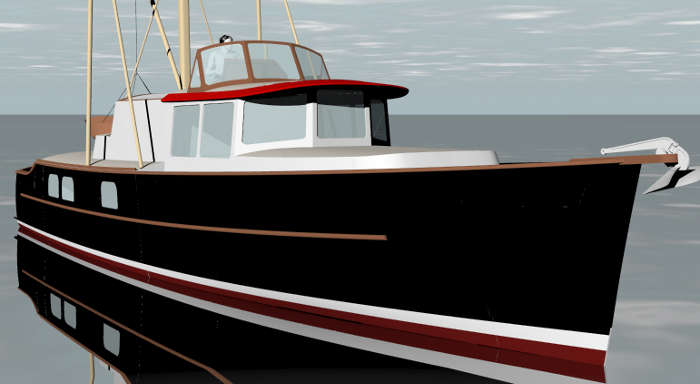
Passagemaker Lite 56 Passagemaker Lite 56

Articles and Reviews (pdfs)

  • Article
    "Passagemaker Lite"
    by Tad Roberts
    Passagemaker
    2002
    html or pdf
  • Article
    "Passagemaker Lite"
    by Tad Roberts
    Professional Boatbuilder
    2003
    html or pdf
  • Article
    "Lightweight Motoryachts: A Brief Background"
    by Tad Roberts
    Passagemaker
    2003
    html or pdf
  • Design Review
    "Passagemaker Lite"
    by Art Paine
    Maine Boats and Harbors
    2003
    html or pdf
  • Design Review
    "Dashew Review"
    by Tad Roberts
    2005
    html or pdf

From Art Paine's Design Review

Maine Boats and Harbors 2003

There is nothing new to the idea of thin, light, seaworthy, and fast powerboats, and Tad Roberts has been inspired by several of those of the past. To Roberts, these boats brought to mind a glaring question: Why didn't the whole world flock to these sensible and efficient pleasure powerboat designs? He answered that question by identifying the elements that limited the type, and, in his Lite designs, addressed them. All in all, the Passagemaker Lite series is masterful work.
Art Paine, Maine Boats and Harbors